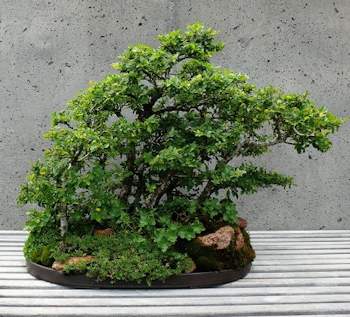
The picture above shows an arrangement of Chinese elm with a nice windswept shape. They grow some wonderful serrated leaves.
Chinese Elm Bonsai 25 Seed/Seeds - Ulmus parvifolia
- Has small evergreen leaves which remain on the tree year - round
- Proper name: Ulmus parvifolia
- Mature Height: 70'
- A lovely park or landscape tree
- 25 Seeds
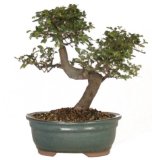
Brussel's CT9005CE Chinese Elm Bonsai
Chinese Elms are deciduous trees with small leaves and fine twigging on their secondary branches. These trees are imported from Chinese nurseries where the branches have been painstakingly trained for years. Chinese Elms are durable and may be displayed indoors for extended periods of time.
I have been growing Chinese Elm from seeds. Here is some pictures and some information.
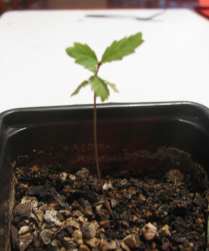
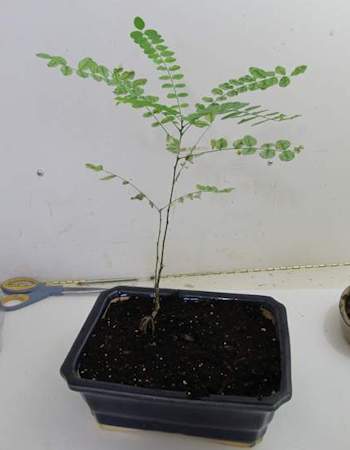
Here is a picture of one of my Chinese Elm bonsai seedlings. This is after about three months.
Chinese elm if started from seed can be raised to be either year round or seasonal.
If you have bought a full grown Chinese Elm bonsai and don't know how it has spent it's years you should be conservative with it to see how it acts. Keep it outdoors in summer then bring it in for the rest of the year. During winter try to find a cooler location within the house. This is a good mild cycle that will allow you to monitor it and adjust so so in later years you can winter it if you want to.
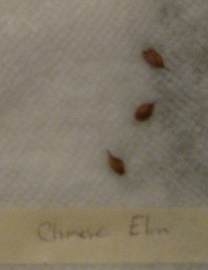
Propagating Chinese Elm from Seed: I have successfully either planted the seeds directly in soil or you can start them out in paper towels.
Watering Your Bonsai: You should water regularly and keep the soil moist even soaking down the soil regularly. Watering can be difficult to explain because of variations in plants sizes, types and soils. But here are some general guidelines:
Stick your finger in the soil checking for moisture. And keep the soil pretty moist. If it is dry then you definitely have to water and you should sometimes water a mature plant by totally soaking it in water. You can do this by filling up a sink with a few inches of water and putting the potted plant right in the water. This allows the water to soak up through the drainage hole and soak the soil completely.
As a bonsai gets older or if it is in a small pot it may be absolutely necessary to water it every day during the growing season. This is because there is very little soil in the container and there is very little water retention.
Watering is a bit of a skill that you learn. You watch and monitor your bonsai over time and over the course of a day after you watered it. You will get a good sense of what good watering is. Whatever you do never let it dry out!
Sunlight: Chinese Elm can take full sunlight but not immediately when you take it home. You should give it partial sunlight so it can adjust. Eventually it will do very well in full sunlight.
Fertilizing: Normal fertilizing rules apply. Typically you never use a regular fertilizer like you would use on vegetables or flowers. You should use a fertilizer specifically made for bonsai. This can be a liquid added to water or pellets. Typically fertilize every two weeks with a liquid fertilizer and once a month with the pellets. Decrease this frequency as the growing season ends and don't fertilize while the tree is wintering.
Pruning and Cutting - The Chinese elm grows quickly and it can take a good amount of pruning. Major cutting and pruning should typically be done in spring when the tree is strongest. Typically you can allow a new shoot to develop eight leaf pairs then trim down to two or three.
This picture shows the seedling above at three years old.
Chinese Elm Bonsai Tree - Medium by Bonsai Boy
- 10 years old specimen, 10" - 12" tall
- Recommended indoor bonsai tree, grown and trained by Bonsai Boy
- Twisted trunk and exposed roots
- Hardy tree with a great shape
Chinese Elm Bonsai 25 Seed/Seeds - Ulmus parvifolia
Has small evergreen leaves which remain on the tree year - round. They are hardy with excellent branching characteristics. Has a twisted trunk and exposed roots which give the appearance of great age. Easy indoor care. A tough attractive tree capable of growing just about anywhere, bark is often patched in varying colours and fall foliage is yellow to reddish purple. A lovely park or landscape tree.

Do you like making projects and exploring a variety of hobbies?
Sign up for my free newsletter. I give you regular updates on hobbies and projects you can make. it is totally free and I don't share your email with anybody.
|