Home

I have a youtube channel with over 1000 Videos!




Hi, Thanks for visiting my website. My name is Will and if you have questions
or would like to
contribute projects or ideas you can contact me 
How to Make Mead From an Ancient 17th Century Recipe
 One of the most attractive things about making mead is the thread of time that it follows. Mead has been made for untold centuries and possibly for a couple of millennium or more. It is a mysterious drink with a very long history and some of this history remains with us to this day. It just is a lot of fun to find and follow one of these ancient recipes to make yourself a mead just like they made hundreds of years ago.
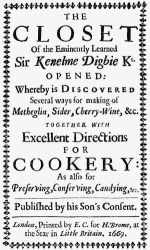
And one of the best sources of old recipes for Mead and Metheglyn comes from a 17th century book called "FROM THE CLOSET OF SIR KENELM DIGBY KNIGHT OPENED". In this book Sir Digby outlines a lot of great recipes and just reading the book is a lot of fun just to see some of the processes that he used to make his mead.
You can download your own copy of this book for free from the gutenberg.org website. Just look up digby as an author.
In this article I am going to take a look at one of the easier recipes and here is how Digby explains it:
TO MAKE EXCELLENT MEATHE
"To every quart of Honey, take four quarts of water. Put your water in a clean Kettle over the fire, and with a stick take the just measure, how high the water cometh, making a notch, where the superficies toucheth the stick. As soon as the water is warm, put in your Honey, and let it boil, skimming it always, till it be very clean;
Then put to every Gallon of water, one pound of the best Blew-raisins of the Sun, first clean picked from the stalks, and clean washed. Let them remain in the boiling Liquor, till they be throughly swollen and soft; Then take them out, and put them into a Hair-bag, and strain all the juice and pulp and substance from them in an Apothecaries Press; which put back into your liquor, and let it boil, till it be consumed just to the notch you took at first, for the measure of your water alone.
Then let your Liquor run through a Hair-strainer into an empty Woodden-fat, which must stand endwise, with the head of the upper-end out; and there let it remain till the next day, that the liquor be quite cold.
Then Tun it up into a good Barrel, not filled quite full, but within three or four fingers breadth; (where Sack hath been, is the best) and let the bung remain open for six weeks with a double bolter-cloth lying upon it, to keep out any foulness from falling in.
Then stop it up close, and drink not of it till after nine months.
This Meathe is singularly good for a Consumption, Stone, Gravel, Weak-sight, and many more things. A Chief Burgomaster of Antwerpe, used for many years to drink no other drink but this; at Meals and all times, even for pledging of healths. And though He were an old man, he was of an extraordinary vigor every way, and had every year a Child, had always a great appetite, and good digestion; and yet was not fat."
Now here is my translation and explanation of how to make this mead recipe yourself. I will stick close to his quantities which will give us about 1 gallon of Mead. You can easily translate this if you want to make a 5 gallon batch.
- Put four quarts of water in a pot and heat it. Mark the side of the pot at the water level.
- Add 1 quart of honey to the water and bring it very gently to a boil. Skim off anything that rises to the surface.
- Put 1 pound of white raisins in a nylon straining bag (or a doubled cheesecloth bag) and drop into the water.
- When they are swollen and soft remove them from the boiling water and press all the juices out of them.
- Add all these juices into the boiling mead.
- Continue to boil the batch down to the mark you made on the pan. This is the four quart level.
- Once this is done cool the liquid and strain it into a fermentation bucket for six weeks.
- After this the fermenation should be almost complete and you can transfer it to a carboy or bottle it where you keep it for nine months before drinking.
Now here are some suggestions I have for varying from the exact recipe.
First off, Digby doesn't say anything about yeast! Eek! How are we going to ferment without yeast. Well, in those days they just took advantage of naturally occuring yeast bacteria that were in the air and the utensils but I don't recommend you do this. We live in a much cleaner world and we want to exercise more control over our Mead so I suggest you pitch a yeast into your batch once it has cooled. Almost any yeast will work including Lalvin D-47 or even Fleischmanns bread yeast. ( Just follow the pitching instructions that come with the yeast)
Secondly, he uses blue raisins which are a bit difficult to come by for us so I recommend you switch to some more run of the mill, and readily available raisins. The raisins do have an effect on the taste but more importantly they act as a nutrient so other types of raisins can be used quite successfully.
Third, about the whole boiling thing. You can successfully do this whole recipe without any of the boiling or heating of anything. Personally I think your mead will be just as good. The reason why Digby boils is because he has to. He got his water from a well and his honey was no doubt heavily contaminated with all kinds of stuff. His boiling of materials would sanitize and clean everything that would compete with the yeast that is desirable to grow. Your sanitizing needs are greatly reduced if you are pitching a real yeast in the brew and you are going to be using extraordinarly clean honey and water by his standards.
Now Enjoy your 17th Century Mead
I can't vouch for whether this mead will cure you of consumption, Stone, Gravel, or weak-sight; heck I don't even know what consumption is. But I do know that you should end up with quite a taste Mead!
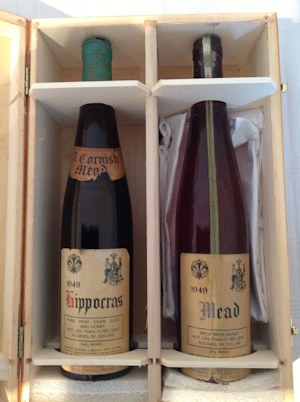
How about some still sealed bottles of mead that are 64 years old? Yup, I have pictures right here. And.... this meadery is long defunct. If you know a little bit about mead you might want to take a look. Maybe you can offer some insight into it. I am looking for help with these beauties. Check out the Guval Mead