About coal selection:
There are variables when it comes to coal. Just like there are variables with everything else. Some of the things you might consider are the type of forge you have, the type of forging you want to do, the amount of money you want to spend among other things. But a good rule of thumb is that you can get a bituminous coal that is metallurgical grade. You can't go wrong with it. You get a hot fire and low smoke, low sulphur.
How much coal do you need?
Bit of a tricky question! This of course depends on how much forging you will be doing. If you are doing an afternoon of forging then 20 pounds of hardwood lump charcoal should be plenty and 5 pounds of coal should do.
How hot the coals burn:
The hardwood lump charcoal burns the coolest but it is more than adequate for most forging. I have used it many times to make knives and swords. Bituminous coal is the next coal, it is a softer coal and it burns hotter than the lump charcoal. Anthracite coal is a hard coal and it burns the hottest.
Which should you use?
For amateur blacksmithing it doesn't matter much. Use whatever you can get. It is when you want to do some really good forging that you need to think about the coal. For example: Need to worry abou the carbon content of a sword you are making? Or the impurities that it will pick up? Then you might want to consider a coal that is metallurgy grade.
Or is time a factor for you? Got a lot of forging to do and need to efficiently get through it? Then you might want the hottest fire which is given with anthracite.
My recommendation
If you are getting into blacksmithing you should try all kinds of coals. Get a feel for them and how they burn, how much smoke they give off and all the other aspects. Blacksmithing is a hands on trade so get your hands on it and experiment/observe.
If you are just tinkering around with blacksmithing it doesn't matter a whole lot what you use and I recommend you pick up a bag of Hardwood Lump Charcoal. I use it all the time and like it a lot. It is available at home improvement stores (only during grilling season) and also available year round on amazon.com:
Here is some on amazon:
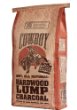
Cowboy Hardwood Lump Charcoal - 20 pound bag
This 20 pound bag will last you a few hours of forging. Depending on how you use it.
Want to start out with a small amount of coal so you can get a sense for it. Depending on your forge and what you are doing you should be able to get a day of forging out of a 16 pound box of it. This stuff has free shipping. It is bituminous coal which means it is the softer coal and easy to light. But very hot.
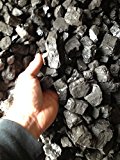
16 pound box of bituminous coal for forging
Here is a 25 pound box if you want more coal!!!
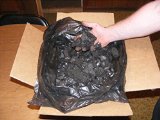
Blacksmithing and Heating Coal 25lbs
25lbs of high BTU Stove Coal. 1.5" to 2.5" nugget size. Coal can be used in model railroading, stoves, forges and foundrys as well as landscaping. Comes shipped in a 12"x12"x6" box.
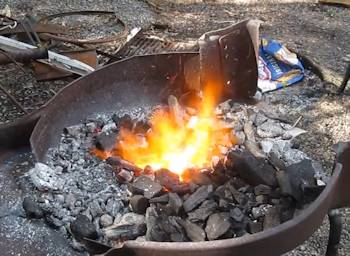
Here is the forge with a Hardwood Lump Charcoal fire.
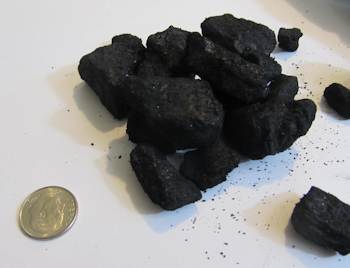
This is bituminous coal. And it is perfect for blacksmithing. These small nugget sized shapes are easy to handle and burn well.
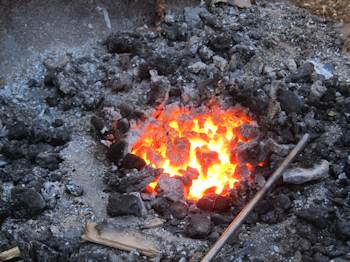
Here is the firepot with Bituminous coal burning. It makes a beautiful fire. Very hot and easy to maintain.
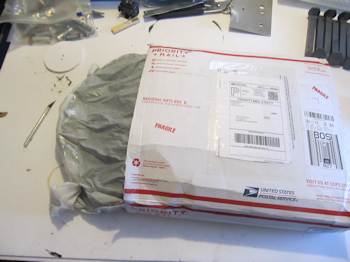
I bought the bituminous coal on ebay. And I got 19 pounds of it stuffed in a shipping box to the max! Yes, maximum coal in that box.
Bituminous Metallurgical coal on ebay
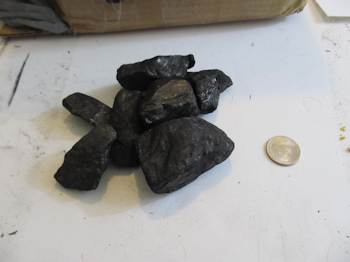
Anthracite Coal - I bought this on ebay also. I got 15 pounds of it. It is harder and the nuggets are more defined.
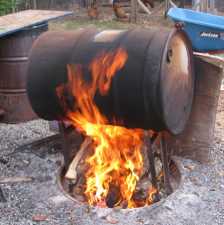
I also have a tutorial on how to make your own lump charcoal from wood. Check that tutorial out right here: How to make hardwood lump charcoal for forging
 Blacksmithing for Beginners - Blacksmithing for Beginners -
This book will get you blacksmithing fast and easy. It is an introductory guide to blacksmithing for people who have little or no experience with the craft. It explains with 50 pictures and illustrations what a forge is, what the tools are, the parts of an anvil, and how it all works. It also shows you the things you will need to get started and where you can get them - and even how to make your own simple forge if you need one.It is a complete introduction to blacksmithing that includes a series of tutorials with pictures showing you step-by-step how to perform basic blacksmithing techniques like pointing and bending. Written in an easy to understand style this book explains to you why the blacksmith heats steel and why the changing color of the steel when heated is important. You will gain an understanding of what blacksmithing is and what the basic techniques and fundamentals are. And this will give you a solid groundwork for moving forward into creating a wide array of objects, tools, and items. This book will give you the confidence and knowledge you need to start hammering hot steel into shape.
|