Some fast and important points you need to know:
- John Points out that the best ratio of counterweight to projectile is 133 to 1 so try to get your counterweight to weigh 133 times that of your projectile!
- Maximum range is attained when the projectile is released between 40 and 45 degrees.
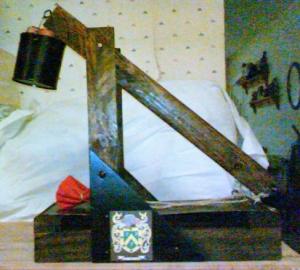 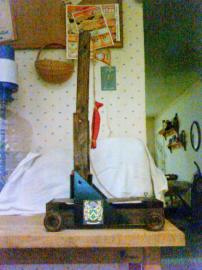
Some specifics about his Trebuchet:
- He added Wheels to his design (You can see the wheels in the picture on the right). They give it a battlefield ready look and they added 25% more power! With the wheels on it this thing looks like it is ready to be rolled out on the battlefield. (The wheels add more power because as the counterweight falls the whole machine moves forward slightly to "meet" the fall thus giving you a more vertical drop leading to more energy being transferred to the throwing arm).
- He added the locking Mechanism that Koji Suggested with his Trebuchet. Koji's treb suggestion
- Beefed up the frame by using 1" x 2" pine stock
- The counterweight is 1.25 Kg and the projectile is 10 grams (This gives him a near optimal performance of 125:1 and optimal is considered to be 133:1 so he is very close!)
- His counterweight is a container with 7 rolls of pennies and some lead shot. (to get 1.25 kg)
- His favorite projectile is a hardened ball of playdoh!
- The axle is a piece of stout welding rod which is perfect!
- The Coat of arms he put on his treb is his actual family crest! Nice!
John has written a presentation on Trebuchets and Transfer of Energy. It has a lot of great information that will be useful to you if you are thinking about making a treb. This is copyright© 2008 John Hall - All Rights Reserved (Thanks John!)
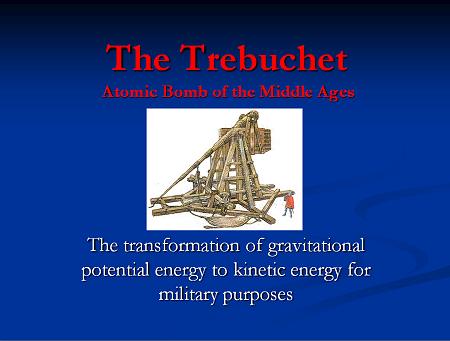
Individual Project
Transfer of Energy
John Hall
History
The trebuchet (O. Fr. - "to overthrow") was a vast improvement on the catapult design in that it used a counterweight and fulcrum to power its throwing arm as opposed to earlier technology which used torsion power by way of twisted rope or sinew. Not only was the trebuchet more powerful than its predecessors, accuracy was improved as well. A catapult had a fixed power, meaning that the entire machine had to be moved to adjust the range. The trebuchet's range could be adjusted simply by adding to or subtracting from the mass of the counterweight. The biggest and most powerful trebuchet ever made, Warwolf , stood over 4 stories tall, weighed 30 tons, had a throwing arm 50 ft. long with a 20 ton counterweight, and could hurl a 300 lb. stone a distance of 900 ft.
Lesser Known History
- Said to have been invented by the Chinese in the 5th century BC, the trebuchet is best known from its use throughout Europe between the 12 th and 15 th centuries before the advent of gunpowder rendered them obsolete.
- Some of the more ruthless besiegers (namely Genghis Khan) got very creative in their choice of projectiles, some of which included casks of burning tar, dung, bodies of Plague victims, beehives, baskets of snakes and scorpions, quicklime, unlucky prisoners-of-war, and even emissaries bearing unsatisfactory peace terms.
- Cortez tried using a trebuchet against the Aztecs as late as 1521, but the very first shot released at an angle of 90 degrees, which led to disaster for the machine and crew.
How it works
- To attain the optimum amount of the transfer of energy the counterweight should be allowed to fall as vertically as possible to gain the most momentum from g (9.80 m/s squared).
- To attain maximum range the release point should be between 40 and 45 degrees.
- To gain more velocity (of course at the cost of distance) a lighter projectile will have a later release point and a flatter trajectory and thus more speed. The angle of the release hook may also be adjusted forward to attain the same result with a heavier projectile.
- Why the wheels add energy: The wheels add more power because as the counterweight falls the whole machine moves forward slightly to "meet" the fall thus giving you a more vertical drop leading to more energy being transferred to the throwing arm.
Experimental Data
The maximum range ballast/projectile weight ratio is 133:1 (2000 kg./15 kg.). Interestingly, Warwolf had the exact same ratio (40,000 lbs./300 lbs.). My model has a ratio of 125:1 (1.25 kg./10 g.).
Miniature trebuchet The Miniature Trebuchet by Timberkits
The trebuchet was the ultimate artillery weapon of the medieval period and early renaissance. A large and unwieldy weapon, it was typically built on-site during battle, and tuned to lob great weights - such as the carcasses of rotting horses and pots of burning pitch, over the castle walls and onto its inhabitants. Precision carved by computer controlled machinery for guaranteed fit and accurate joinery. The detailed instructions include loads of photos of each step of the construction process, tuning tips and safety notes. Included in the kit are four wooden projectiles, all the necessary components for the sling, trigger, and counterweight bucket as well as all the parts for the kit. The only thing you'll need to supply are 88 pennies for counterweight and a few simple tools - Scissors, a ruler, a utility knife, wood glue and a few rubber bands to hold the pieces together while the glue dries. Manufactured by RLT Industries
The Miniature Trebuchet - The trebuchet was the ultimate artillery weapon of the medieval period and early renaissance. A large and unwieldy weapon, it was typically built on-site during battle, and tuned to lob great weights - such as the carcasses of rotting horses and pots of burning pitch, over the castle walls and onto its inhabitants. This is our newest and smallest trebuchet design in a long line of catapult kits. Designed by master trebuchet expert Ron Toms, this machine is ideal for the student on a budget or as a wonderful display piece for any desktop or bookshelf of any history enthusiast. Precision carved by computer controlled machinery for guaranteed fit and accurate joinery. The detailed instructions include loads of photos of each step of the construction process, tuning tips and safety notes. Included in the kit are four wooden projectiles, all the necessary components for the sling, trigger, and counterweight bucket as well as all the parts for the kit. The only thing you'll need to supply are 64 pennies for counterweight and a few simple tools - Scissors, a ruler, a utility knife, wood glue and a few rubber bands to hold the pieces together while the glue dries. Tools required: Scissors, Glue, Ruler, rubber bands and a utility knife. Sandpaper is optional. Additional Counterweight Required: 64 pennies. Range: About 10 feet.
|