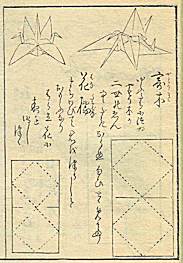
The very first book on Origami was published in 1797 and it was on how to fold the traditional crane. The book was titled Hiden Senbazuru Orikata.
The Still Evolving Art
Origami has been changing, growing and evolving over the centuries. It spent a period of time as just a novelty with a few different items that were commonly made. And it spent a period of time in the realm of the magicians. Yes, creative paper folding was a part of many a magicians act. This can be testified by the fact that even Harry Houdini published a book (1922) called: "Houdini's Paper Magic". Another early type of origami is called Kusadama and this is the precursor to modern day modular origami. And a recently evolved version of the art is Mathematical Origami. There are many branches of the art and there will still be more to come. It is a still growing pursuit and craft.
The History of Origami very much coincides with the history of paper and there have been pockets of paper folding that spread across many centuries and many countries. But it is very difficult to know the real beginnings of the art and much has been lost. This is predominantly due to the nature of the art -it is done with paper! And that means it doesn't hold up over the centuries.
But we do have some anecdotal evidence that some paper folding was done centuries ago. This evidence usually is some kind of drawing on parchment or papyrus or a mention in a book that shows or explains objects that seem to be paper folded items.
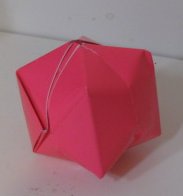
We get some solid evidence of Origami beginning in the 17th Century. This of a mention of the Water Bomb Base or Balloon Base. There is evidence of this dating as early as 1614. It was also called a paper prison and it could hold a fly which would increase the sound of their buzzing or could hold water thus making it a water-bomb!
I have instructions on how to fold this, and more information about it here: The Origami Water Bomb.
In the 19th century and early 20th century Origami had found some popularity particulary and variations of Origami started to spread, often with the angle of magic. The flapping bird is one exampe of this that was very popular. Even Harry Houdini wrote a book on paper magic that is still available today.
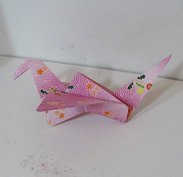
Here is an example of a standard origami flapping bird. You pull on the tail and the wings will flap up and down. There are many variations on this bird. I have a tutorial that shows you how to make it here: The Origami Flapping Bird
In the early 20th century books about the art of paper folding started appearing and they were mostly aimed at being amusements for kids. Some of the books are Houdini's Paper Magic, Fun with Paper folding by W.D. Murray and F.J. Rigney and Paper Magic by Will Blythe.
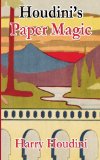
Houdini's Paper Magic
This volume is divided into four parts: Paper Tricks (23 tricks); Paper Folding (7 tricks); Paper Tearing (11 tricks); and finally Paper Puzzles (16 tricks). Most, if not all, are illustrated with "how-to" diagrams. Houdini's Pager Magic is written as though Houdini dictated it directly to the reader, as if he was explaining a magic trick to someone sitting across his dining room table.
The Modern Age of Origami
Two men are credited with bringing origami into the modern age and with transforming it from a simple novelty to an art form with many variations. They dramatically increased the range of folds and possibilities. These two men were Miguel Unamuno of Spain and Akira Yoshizawa of Japan.
 Unamuno was part of a paper folding movement (papiroflexia) in both spain and argentina but this movement did not spread to the rest of the world. It stayed pretty much to those countries. Unamuno was part of a paper folding movement (papiroflexia) in both spain and argentina but this movement did not spread to the rest of the world. It stayed pretty much to those countries.
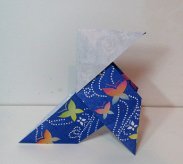
One of the more popular folds to come out of that movement was the Pajarita or Little bird. A picture of this is shown on the right. I have instructions on how to fold the Pajarita here
Akira Yoshizawa (1911 - 2005)
It is with Akira that origami was changed forever and brought to new heights not just as a novelty but as a creative art. He spent his early years in poverty but around the age of 40 things changed for him and for his origami. He designed a series of Origami zodiac models for a picture magazine called Asahi Graph which was published in 1951. It was this publication that turned him into an overnight sensation which lead to more publications and work. In 1954 he published his first of many origami folding books called Atarashi Origami Geijutsu (New Origami Art). He also created the paper folding notation called the Yoshizawa-Randlett system that is still used today. And he founded teh International Origami Center in Tokyo in 1954. Another of his books now considered a classic is Origami Dokuhan which was published in 1957.
He also created the technique called Wet folding where the paper was moistened to allow it to be folded and curved in new ways. One of his most famous works "The Gorilla Face" uses this technique.
in the 1960's Yoshizawa embarked on a world tour of 30 countries to promote the art and craft of Origami and to act as a cultural ambassador to Japan. For his achievements in the art the Emperor of Japan awarded him the Order of the Rising Sun.
Some of his more famous books:
- Atarashi Origami Geijutsu (New Origami Art)
- Sosaku Origami -
 (Creative Origami) (Creative Origami)
- Tanoshi Origami - (Joyful Origami)
- Origami Museum I: Animals (v. 1)
RESOURCES
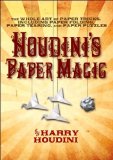 
Houdini's Paper Magic, the Whole Art of Paper Tricks, Including Paper Folding
Is it true that a magician never reveals his secrets? In this rare 1922 gem, master illusionist Harry Houdini may not explain how to make an elephant disappear or how to perform fantastic acts of escape, but he does divulge dozens of terrific sleight-of-hand tricks and puzzles anyone can do with paper. Divided into four parts�paper tricks, paper folding, paper tearing, and paper puzzles Houdini's Paper Magic is an accessible and easy-to-follow guide to all sorts of tricks with paper. In addition to magic like The Traveling Paper Balls and The Spirit Communication, Houdini delves into traditional origami such as The Japanese Bird� and The Bullro.g He also show how paper torn carefully and properlly can produce elegant and intricate structures such as a ladder, a trellis, and a fir tree. Finally, he offers a number of paper puzzles that will challenge the mind. Houdini's Paper Magic is a wonderful glimpse back into the history of the art of magic and essential for anyone interested in learning tricks and techniques from one of magic�s greatest conjurers.
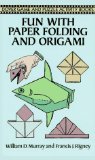 
Fun with Paper Folding and Origami (Dover Game and Puzzle Activity Books)
Easy-to-follow instructions for over 40 different pieces: sailboat, rooster, battleship, pagoda, bird, frog, airplane, cradle, Japanese lantern and many more. Crystal-clear text and more than 275 diagrams showing each stage in the paper folding process. Specially written to anticipate beginners' difficulties. 279 diagrams.
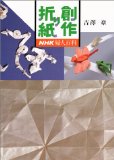
Sosaku Origami - Creative Origami

Do you like making projects and exploring a variety of hobbies?
Sign up for my free newsletter. I give you regular updates on hobbies and projects you can make. it is totally free and I don't share your email with anybody.
|